Picket Spacing Calculator
Find the equal gap between fence pickets and where to mark each one from the post.
Fence layout
Results
A 92-1/2" section takes 10 pickets with 3-7/16" gaps, including the gap at each post.
Equal gap
3-7/16" (3.41 in)
Every opening is 4 in or less, the opening size CPSC uses to keep a young child's head and chest from passing through.
Cut one spacer block to the exact gap and hang each picket against its mark from the post face; the block only checks the result, the marks set it.
Pickets per section: 10 pickets
Picket spacing on centre: 8-15/16"
| Picket | Left edge | Centre |
|---|---|---|
| 1 | 3-7/16" | 6-3/16" |
| 2 | 12-5/16" | 15-1/16" |
| 3 | 21-1/4" | 24" |
| 4 | 30-1/8" | 32-7/8" |
| 5 | 39-1/16" | 41-13/16" |
| 6 | 47-15/16" | 50-11/16" |
| 7 | 56-7/8" | 59-5/8" |
| 8 | 65-3/4" | 68-1/2" |
| 9 | 74-11/16" | 77-7/16" |
| 10 | 83-9/16" | 86-5/16" |
How this works
A section between two posts holds n pickets and n + 1 gaps, so the gaps at the posts match the gaps between pickets. For an 8 ft on-centre bay with 4x4 posts, the clear width is 92-1/2 in. Ten 5-1/2 in pickets fill 55 in of it, and the 37-1/2 in left over splits into 11 equal gaps of about 3-7/16 in. Each picket's mark is measured from the left post face, so one tape hooked on the post sets every picket. To count how many pickets, rails and posts to buy for the whole fence, see the fence calculator.
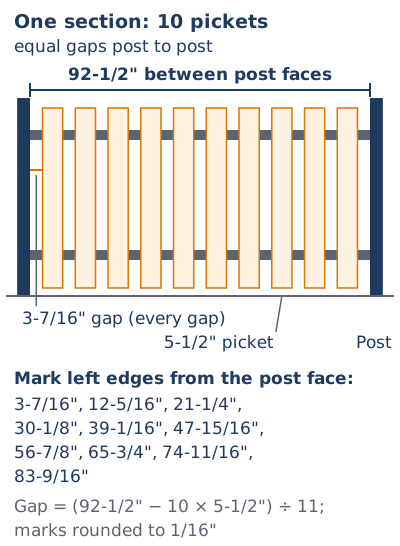
The calculator treats each section as a row of n pickets and n + 1 equal gaps, one at each post and one between every pair of pickets. With a clear width W between post faces, picket width w and maximum gap g, it starts from n = floor((W − g) ÷ (w + g)) and adds one picket if that count still leaves a gap above g, which gives the fewest pickets whose gap is at or under your maximum. The exact gap is g′ = (W − n·w) ÷ (n + 1). The left edge of picket i is i·g′ + (i − 1)·w from the left post face, and its centre is half a picket further. Each mark is rounded to the nearest 1/16 in on its own, never added up from rounded steps, so no mark is more than 1/32 in from its exact place. If one more picket would not fit, the calculator says so instead of showing a gap above your maximum. In whole-run mode, the run length from end post centre to end post centre is divided into the fewest equal sections no wider than your maximum post spacing; the default 8 ft maximum is the same post-spacing figure the fence calculator uses. One post width comes off each on-centre spacing to give the clear width the pickets fill, and every section then gets the same layout. The optional pool check compares the equal gap with CPSC Pub. 362: when the tops of the horizontal rails are less than 45 in apart, verticals may be at most 1-3/4 in apart; otherwise the limit is 4 in. All maths runs in metres and the unit toggle changes only what you see.
Sources: Pool barrier limits: CPSC Pub. 362, "Safety Barrier Guidelines for Residential Pools"; 4x4 post and 1x6 picket sizes: PS 20-20 American Softwood Lumber Standard, Table 3.
Worked example: one 8 ft section with 4x4 posts
Posts 8 ft (96 in) on centre with 3-1/2 in 4x4 posts leave 96 − 3-1/2 = 92-1/2 in between faces. With 5-1/2 in pickets and a 4 in maximum gap, floor((92.5 − 4) ÷ (5.5 + 4)) = floor(9.32) = 9 pickets would leave (92.5 − 9 × 5.5) ÷ 10 = 4.3 in gaps, which is over 4 in. Ten pickets give (92.5 − 55) ÷ 11 = 3.41 in, about 3-7/16 in, for every gap including the two at the posts. Marked from the left post face, the left edges fall at 3-7/16, 12-5/16, 21-1/4, 30-1/8, 39-1/16, 47-15/16, 56-7/8, 65-3/4, 74-11/16 and 83-9/16 in. The last picket's right edge is at 89.09 in, which leaves exactly one 3.41 in gap to the far post face at 92.5 in.
A second example: a 50 ft run with posts at most 8 ft apart
A 50 ft run measured end post centre to end post centre: 50 ÷ 8 = 6.25, so 7 equal sections and 8 posts. Each section is 50 ÷ 7 = 7.14 ft, about 85-11/16 in on centre, and 85.71 − 3.5 = 82.21 in between faces. With the same 5-1/2 in pickets and 4 in maximum gap, 8 pickets leave 4.25 in gaps, so the layout uses 9 pickets at (82.21 − 49.5) ÷ 10 = 3.27 in, about 3-1/4 in. Every section in the run uses the same marks, so you can cut one story stick and reuse it on all 7 sections.
Pool barrier check: rails 36 in apart
If the same 92-1/2 in section is part of a pool barrier with the tops of its rails 36 in apart, CPSC Pub. 362 limits the space between verticals to 1-3/4 in, because rails less than 45 in apart are climbable. The 3-7/16 in layout fails. Setting the maximum gap to 1-3/4 in gives 13 pickets at (92.5 − 13 × 5.5) ÷ 14 = 1.5 in, which passes. With the rails 45 in or more apart the limit is 4 in, and the original 10-picket layout passes.
Common mistakes
Measuring post centre to post centre for the section width
Pickets fill the clear space between the post faces, not the on-centre distance. An 8 ft on-centre bay with 4x4 posts is 92-1/2 in between faces, not 96 in. Using 96 in adds about one picket and shrinks every gap.
Using the nominal picket width
A "1x6" picket is 5-1/2 in wide and a "1x4" is 3-1/2 in, per the American Softwood Lumber Standard. Entering 6 in or 4 in shifts every mark and can change the picket count. Measure a few real pickets and use the typical width.
Laying out from the first picket instead of the post face
All marks in the list are measured from the face of the left post. If you hook the tape on the edge of a picket you just hung, any error in that picket carries into the next one. Go back to the post face for every mark.
Picking a gap first and letting the last gap fall where it lands
Hanging pickets at a fixed 3 in gap with a spacer block leaves one odd gap at the far post, often half a gap or a sliver. Let the calculator choose the picket count and the equal gap, then cut your spacer block to that gap.
Rounding the gap instead of the marks
If you round the gap to the nearest 1/8 in and step it along, the error grows with every picket and the last gap comes out wrong. Round each mark from the post face on its own, which is what the list does.
Assuming a pool fence only needs to be tall
A pool barrier with its rails less than 45 in apart can have no more than 1-3/4 in between verticals under CPSC Pub. 362, so a child cannot use the rails as a ladder. A typical 3 to 4 in garden-fence gap fails that rule.
When this layout stops applying
- Sloped ground: on a racked fence the rails follow the slope, and the gap is measured square to the pickets, which is the same as on flat ground. On a stepped fence each section is level, so lay out each section on its own.
- Pickets that touch or overlap, such as board-on-board or shadowbox styles: there is no equal gap to solve for. Use the fence calculator's count for these styles instead.
- Posts that are not plumb or sections that are wider at the top than the bottom: measure the clear width at the rail you will mark on, and use the narrower of the two if they differ.
- Pre-built panels: the panel maker fixes the spacing, so you only need the post spacing. Use whole-run mode with the panel's on-centre spacing as the maximum and check the panel's own instructions.
- Curved runs: the run length along a curve is longer than the straight line between end posts. Measure along the curve and keep the post spacing tight so the rails can bend.
- Gates: lay out a gate as its own section using the gate frame's clear width. The gap at the hinge and latch posts is set by the hardware, not by this layout.
- Pool barriers: the check covers only the space between vertical members. Barrier height, bottom clearance, gates, latches and nearby climbable objects need their own check against your local code.
FAQ
Why are the gaps next to the posts the same as the gaps between pickets?
Because that is what makes a section look evenly spaced from the street. If you start the first picket tight against the post, all the leftover width ends up in one odd gap at the far post. Splitting the section into n + 1 equal gaps puts one gap at each post and one between every pair of pickets, so nothing looks squeezed.
Should I use the left-edge marks or the centre marks?
Use whichever edge your eye or your jig sits on. Left-edge marks suit hanging each picket so its edge touches a pencil line. Centre marks suit a picket with a centre screw line or a pointed top you want to line up. Both lists are the same layout, offset by half a picket width.
What if my sections are not all the same width?
Run each section through the calculator on its own. Posts rarely land exactly where planned, so measure the real clear width between the post faces after the posts are set and before you cut or hang pickets. A section that is 1/2 in narrower than its neighbour will get a slightly smaller gap, which is invisible across a run.
Why does the calculator sometimes add one more picket than I expected?
It always picks the fewest pickets whose gap is at or under your maximum. Starting from floor((W − g) ÷ (w + g)) can leave a gap just above your maximum, and one more picket pulls it back under. If you would rather have the slightly wider gap, raise the maximum gap a little and the count drops by one.
What does it mean when no equal gap fits?
Your maximum gap is so small that one more picket would not fit, but one fewer leaves a gap above your maximum. The calculator shows the wider layout it would have used. Either accept that gap by raising the maximum, or rip one picket narrower so the rest can sit at the tighter spacing.
Can I use this for horizontal slat fences?
Yes, if you turn the problem on its side: enter the clear height between the bottom and top rails as the section width, the slat height as the picket width, and your maximum gap. The marks then run up from the lower rail instead of across from the post.
How do I transfer 1/16 in marks without a long measuring error?
Hook the tape on the post face and mark every position from that one zero point. Adding one gap and one picket at a time with a short tape lets small reading errors pile up. Each mark in the list is rounded to 1/16 in on its own, so working from one zero keeps every picket within 1/32 in of its exact place.
Does a pool barrier need anything besides the picket gap?
Yes. CPSC Pub. 362 also covers barrier height, the gap under the barrier, gate latches and climbable objects next to the fence. This calculator checks only the space between vertical members. Treat the check as a planning aid and confirm the full barrier against your local pool code, which may be stricter.
Why is the default maximum gap 4 inches?
Four inches is the opening CPSC uses so a young child's head and chest cannot pass through a pool barrier. It is a sourced, conservative starting point for an open picket fence. A garden fence with no safety role can use any gap you like, so change it to suit your style.
Does the post width matter in whole-run mode?
Yes. The run is measured from end post centre to end post centre, so every section loses one post width from its on-centre spacing: half a post at each end. The calculator subtracts it to get the clear width the pickets actually fill. A 6x6 post at 5-1/2 in leaves 2 in less per section than a 4x4 at 3-1/2 in.
Is a story stick faster than measuring every section?
Yes, when the sections in a run share one clear width, as they do in whole-run mode. Transfer the marks once onto a straight 1x2 cut to the clear width, hold it against the post face at the rail, and tick each picket position. Re-measure any section where a post landed off its mark before you reuse the stick.
How do I match new pickets to an existing fence section?
Measure the clear width of a section you are not changing, its picket width and its picket count, then enter the width and picket size with a max gap just above the gap you measured. If the calculator returns the same count, its marks reproduce the old layout; if not, the old fence was not equally spaced.