Concrete Steps Calculator
Work out how much concrete, in cubic yards and pre-mix bags, a set of solid poured steps and an optional top landing needs.
Step dimensions
Results
For 3 steps with a 7" riser and a 11" tread, 4' 0" wide, you need about 0.48 cu yd (12.83 cu ft) of concrete: 22 bags of 80 lb, 29 bags of 60 lb or 43 bags of 40 lb pre-mix.
Concrete needed
0.48 cu yd (12.83 cu ft)
The 7" riser and 11" tread are within the IRC limits (riser at most 7-3/4", tread at least 10").
Some jurisdictions amend these limits, so confirm them with your building department before you build the forms. This is a material estimate, not an engineering design: footings and reinforcement follow your local code.
80 lb bags (≈ 0.60 cu ft each): 22
60 lb bags (≈ 0.45 cu ft each): 29
40 lb bags (≈ 0.30 cu ft each): 43
Total rise: 1' 9"
Total run: 2' 9"
How this works
To find how much concrete you need for steps, multiply width × riser height × tread depth × n(n+1)/2, where n is the number of steps, then add width × landing depth × total rise if there is a landing at the top. For 3 steps with a 7 in rise and an 11 in run, 4 ft wide, that is 12.83 cu ft (0.48 cu yd), or 29 bags of 60 lb concrete mix (22 bags of 80 lb). Steps with a slab or footing under them need that part estimated separately with the concrete calculator.
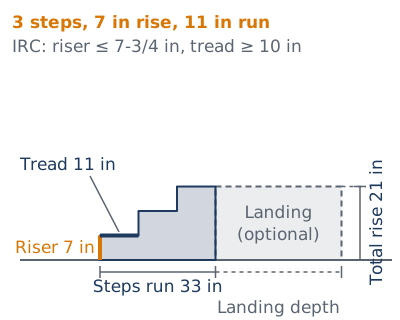
Each step is a solid column from the ground to its tread. With n steps, the columns are 1, 2, … n risers high and one tread deep, so the steps hold width × riser × tread × (1 + 2 + … + n), and 1 + 2 + … + n is n(n+1)/2. The optional landing sits behind the top tread and is as tall as the whole flight, so it adds width × landing depth × n × riser. The landing depth is measured from the back of the top tread, which keeps the top tread from being counted twice. Volume is shown in cubic feet and cubic yards (1 cu yd = 27 cu ft, an exact conversion), or in cubic metres in metric mode. Bag counts divide the volume by Quikrete's published yield per bag and round up to a whole bag; no waste allowance is added. The riser and tread you enter are checked against the IRC limits: a riser not more than 7-3/4 in and a tread not less than 10 in. All maths runs in metres and the unit toggle changes only what you see. The result is a material estimate, not an engineering design: footings, reinforcement and how the steps attach to a house follow your local building code.
Sources: Bag yields (40 lb ≈ 0.30 cu ft, 60 lb ≈ 0.45 cu ft, 80 lb ≈ 0.60 cu ft): Quikrete Concrete Mix (No. 1101) data sheet (checked 2026-10-30); Riser and tread limits (riser max 7-3/4 in, tread min 10 in, 3/8 in riser variation): IRC R311.7.5, via the ICC's published code (checked 2026-07-27).
Worked example: 3 steps without a landing
Three steps, each with a 7 in riser and an 11 in tread, 4 ft (48 in) wide. The columns under the treads are 1, 2 and 3 risers high, so the steps hold 1 + 2 + 3 = 6 blocks of 48 × 7 × 11 in. That is 6 × 3,696 = 22,176 cu in, or 12.83 cu ft (22,176 ÷ 1,728), which is 0.48 cu yd (12.83 ÷ 27). With Quikrete's yields, that is 29 bags of 60 lb (12.83 ÷ 0.45 = 28.52, rounded up), 22 bags of 80 lb (12.83 ÷ 0.60 = 21.39) or 43 bags of 40 lb (12.83 ÷ 0.30 = 42.78). The riser is under the 7-3/4 in IRC maximum and the tread is over the 10 in minimum, so the check passes.
A second example: 4 steps up to a 36 in landing
Four steps of 7 in by 11 in, 4 ft wide, rising to a landing 36 in deep behind the top step. The steps hold 1 + 2 + 3 + 4 = 10 blocks of 48 × 7 × 11 in, or 21.39 cu ft. The landing is a solid block at the full 28 in height (4 × 7 in): 48 × 36 × 28 in = 28.00 cu ft. Together that is 49.39 cu ft, or 1.83 cu yd, which is 110 bags of 60 lb or 83 bags of 80 lb. The landing holds more concrete than the four steps, so leaving it out would miss more than half the order.
Common mistakes
Measuring the steps as one big box
Height × depth × width of the whole flight treats the steps as a solid block. For 3 steps that counts 9 step-sized blocks instead of 6, about 50% too much concrete. Use the staircase formula, which counts each column at its own height.
Counting the top tread twice with the landing
If the landing depth you enter already includes the top tread, that tread is counted once as a step and again as part of the landing. Measure the landing from the back of the top tread.
Forgetting the landing is the full height
A landing behind the top step is as tall as the whole flight. With 4 steps of 7 in, a 36 in landing on a 4 ft wide set holds more concrete than the four steps together. Leave it out of the estimate and the order comes up well short.
Building the forms before checking the riser and tread
A riser over 7-3/4 in or a tread under 10 in fails the IRC limits used here. Fix the layout on paper first: more steps lower each riser, and deeper treads lengthen the run. Changing a set of formed or poured steps is far harder.
Using the outside of the forms as the width
The concrete fills the space inside the forms. Measure the width between the inside faces of the side forms, not across the outside of the boards.
When this estimate stops applying
- Steps that tie into a house foundation, a deck or a retaining wall: the connection and any footing are a structural detail for your local code and, where needed, an engineer. This tool does not size them.
- Footings and frost depth: the footing under the steps, and how deep it goes, depend on local code and soil. Estimate a separate footing with the concrete calculator.
- Reinforcement: whether the steps need rebar or mesh is set by local code; this tool does not decide it. The rebar calculator lays out bars once you know the grid.
- Hollow or partly filled steps: the volume here assumes solid concrete. Subtract any fill you plan yourself.
- Flared, curved or wrap-around steps, and steps with side walls: model the straight run here and add the extra pieces as separate blocks.
- Steps that follow a slope on both sides, or a flight split by a mid-landing: run the calculator for each straight section and add the results.
FAQ
Does the volume assume the steps are solid concrete all the way down?
Yes. Each step is treated as a solid column from the ground up to its tread, so the bottom step is one riser tall and the top step is the full height. If you plan to fill part of the inside with something other than concrete, the bag count here is the upper limit; work out the filled volume yourself and subtract it.
My porch or platform depth includes the top step. What do I enter for the landing?
Enter the depth behind the top step only. The top tread is already counted as a step, so the landing depth starts at the back of that tread. If you measured the whole flat area at the top, including the top tread, subtract one tread depth before you enter it.
Can I pour the steps on top of an existing slab or patio?
Yes, the same formula applies. Measure the first riser from the top of the existing slab, not from the ground beside it, and enter the same riser height for every step. Whether the new steps need to be tied or pinned into the old slab is a detail for your local code.
Does the bag size change how much concrete I end up with?
No. The bag size only changes how many bags you carry. Quikrete lists about 0.30 cu ft for a 40 lb bag, 0.45 cu ft for a 60 lb bag and 0.60 cu ft for an 80 lb bag, which is the same amount of concrete per pound in every size. Pick the bag you can lift and mix comfortably; the total weight of the order is about the same.
Is a riser of exactly 7-3/4 in allowed?
Yes. IRC R311.7.5.1 says the riser height shall be "not more than" 7-3/4 in, so a riser of exactly 7-3/4 in passes and anything taller is flagged. The tread rule works the same way in the other direction: R311.7.5.2 says "not less than" 10 in, so a 10 in tread passes. Local codes can amend both limits, so confirm the figures with your building department.
Why does the metric check accept 19.685 cm when the code prints 196 mm?
Because the calculator checks the inch figure, 7-3/4 in, which is 196.85 mm exactly. The IRC prints 196 mm next to it as a rounded metric value. If your local code is written in metric, treat 196 mm as the limit and keep the riser at or under it.
Does this include a footing or rebar under the steps?
No. This tool estimates the concrete in the steps and landing only. It is not an engineering design: footings, frost depth, reinforcement and how the steps tie into a foundation are set by your local building code and, where needed, an engineer. Size any separate footing with the concrete calculator and the bars with the rebar calculator.
What if my steps have side walls or a wider bottom step?
Enter the steps as one straight run of the same width and add the extras separately. Side (cheek) walls, flared bottom steps and curved fronts are not in the model. Work out each extra piece as a simple block with the concrete calculator and add its volume to the result here.
Should my risers all be the same height?
Yes. The IRC allows the tallest riser in a flight to exceed the shortest by no more than 3/8 in, which is why this calculator takes one riser height for every step. If the ground slopes across the bottom step, set the forms so the top of each tread keeps the same riser height.
How many bags should I buy beyond the count shown?
The count is already rounded up to whole bags, but it includes no waste allowance. Forms that bow outward, a base that dips below grade or a spill all use extra concrete. A spare bag on hand lets you finish the pour without stopping; check whether your store takes back unopened bags.