Paver Base Calculator
Work out how much compacted base gravel, bedding sand and polymeric sand to buy for a paver patio, walkway or driveway.
Paved area
Layers
Base thickness is after compaction. Clay, wet soil or a cold climate needs a thicker base.
Results
For a 12 × 12 ft area on a 4 in base, order about 3.21 tons (2.30 cu yd) of compacted base, 0.66 tons of bedding sand and 3 bags of polymeric sand.
Compacted paver base (gravel)
3.21 tons · 2.30 cu yd
That's 129 bags of base — more than most people want to carry and empty by hand.
Price the base in bulk by the ton from a landscape or aggregate supplier, and spread and compact it in lifts rather than all at once.
| Layer | Volume | Weight | Bags |
|---|---|---|---|
| Compacted base | 2.30 cu yd | 3.21 tons | 129 × 50 lb |
| Bedding sand | 0.49 cu yd | 0.66 tons | 27 × 50 lb |
| Polymeric joint sand | — | — | 3 × 50 sq ft bag |
Paved area: 144 sq ft
Base area incl. extension: 169 sq ft
Base extension on each restrained side: 6 in
How this works
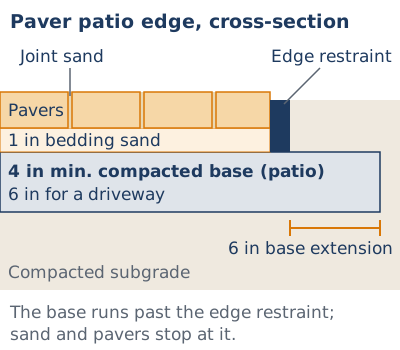
To find how much paver base you need, multiply the base area by the compacted base thickness and add an allowance: a patio or walkway needs at least 4 in of compacted base and a driveway at least 6in, and the base runs past the edge restraint, so its area is larger than the patio's. For a 12 x 12 ft patio that is about 2.30 cu yd, or 3.21 tons, of base with the 10% allowance. On top of the base goes a 1 in screeded layer of bedding sand under the pavers only, then polymeric sand swept into the joints. Count the pavers themselves with the paver calculator.
The paved area comes from length × width, or from the area and perimeter you enter. The base footprint is the paved area grown by the extension on every restrained side: A + P × E + 4E². For a rectangle this is the same as (L + 2E) × (W + 2E). The extension E comes from the ICPI table: 6 in for a base up to 6 in thick, equal to the base thickness from 6 to 10 in, and 10 in from 10 to 20 in. Base volume is that footprint × the compacted base thickness × (1 + allowance). Bedding sand volume is the paved area alone × the bedding thickness × (1 + allowance). Tons use the same densities as the gravel and sand calculators, 1.4 and 1.35 tons per cubic yard. Bags are the weight in pounds ÷ the bag weight. Polymeric sand bags are the paved area ÷ the label's coverage per bag. Every bag count is rounded up to a whole bag. All maths runs in metres and the unit toggle changes only what you see.
Sources: Base and bedding depths, joint width: CMHA PAV-TEC-002, Construction of Interlocking Concrete Pavements (formerly ICPI Tech Spec 2); Base extension table and tolerances: CMHA PAV-MAN-006, Construction Tolerances for ICP (ICPI); 50 lb bags and 1 to 2 in sand bed: QUIKRETE Patio Paver Sands data sheet; Polymeric sand coverage: Techniseal EZSAND product page, checked 2026-10-30. The 10% allowance is a BuildyWork planning default with no external source claimed.
Worked example: a 12 x 12 ft patio
A 12 x 12 ft patio is 144 sq ft with a 48 ft perimeter. A patio gets 4 in of compacted base, and ICPI's table gives a 6 in extension for a base that thick, so the base covers 13 x 13 ft = 169 sq ft. 169 sq ft × 4/12 ft = 56.33 cu ft, and the 10% allowance makes it 61.97 cu ft, or 2.30 cu yd. At 1.4 tons per cubic yard that is 3.21 tons, or 129 bags of 50 lb gravel. The bedding sand covers the 144 sq ft only: 144 × 1/12 ft = 12 cu ft, plus 10% is 13.2 cu ft (0.49 cu yd). At 1.35 tons per cubic yard that is 0.66 tons, or 27 bags of 50 lb sand. At 50 sq ft per bag, the joints need 3 bags of polymeric sand. At 129 bags, a bulk delivery of base by the ton is usually easier than hauling bags.
A second example: a 10 x 20 ft driveway pad
A 10 x 20 ft parking pad is 200 sq ft with a 60 ft perimeter. A driveway needs 6 in of compacted base, and the extension is still 6 in, so the base covers 11 x 21 ft = 231 sq ft. 231 × 6/12 ft × 1.1 = 127.05 cu ft, or 4.71 cu yd, which is 6.59 tons of base. The bedding sand is 200 × 1/12 × 1.1 = 18.33 cu ft (0.68 cu yd), or 0.92 tons. The base for this pad is about twice the patio's on only 39% more paved area, because the base is half again as thick and covers a wider footprint.
Common mistakes
Ordering base for the paver area only
The base runs past the edge restraint on every restrained side. On a 12 x 12 ft patio with a 4 in base, the 6 in extension turns 144 sq ft into 169 sq ft of base, about 17% more gravel. Leaving it out is the most common reason a base order comes up short.
Using bedding sand as a leveling layer
Screed the sand to a uniform 1 in over a base that is already flat. A sand bed that is 1/2 in in one spot and 2 in in another compacts unevenly, and the pavers settle into the deep spots. Fix the base, not the sand.
Measuring the base depth before compaction
ICPI's 4 in and 6 in are compacted thicknesses. Loose gravel spread 4 in deep ends up thinner after the plate compactor passes. Spread and compact in lifts, then check the finished depth against the target.
Using stone dust or masonry sand for the bedding layer
ICPI says masonry sand, limestone screenings and stone dust should not be used for bedding. They often do not compact evenly and can keep water from draining out of the bedding layer. Use a concrete-grade bedding sand.
Buying polymeric sand by the paver area at the best-case coverage
Label coverage is an "up to" figure for narrow joints on regular pavers. Coverage varies with the paver, and wider joints hold more sand. Buy one extra bag, or use the low end of the label's range.
Using the driveway preset for a patio, or the other way round
The driveway preset is 6 in of base, half again the patio's 4 in. A driveway on a 4 in base is below ICPI's minimum for car traffic. A patio on a 6 in base works, but it uses half again as much gravel.
When this estimate stops applying
- Permeable pavers: the ICPI tolerance guide used here says it does not apply to permeable interlocking concrete pavements. Follow the paver maker's or a designer's base for those.
- Streets, parking lots and heavy trucks: ICPI gives 8 to 10 in as the minimum base for residential streets and says a civil engineer should set the base for streets and heavy-duty pavements. This tool stops at 12 in and is meant for patios, walkways and home driveways.
- Pavers set in mortar or on a concrete slab: there is no compacted gravel base or loose bedding sand to estimate.
- Curved or irregular patios: use the area entry with the measured perimeter. The extension adds square corners, so curves come out slightly high, which errs toward enough base.
- Edges against a house, a slab or a wall that holds the pavers: enter only the restrained edge length as the perimeter so those sides get no extension.
- Wet, clay or frost-prone soil: the ICPI minimums assume well-drained soil. Enter the thicker base your local supplier or building department recommends.
- A base material much lighter or heavier than crushed stone: the tons and bags use the gravel calculator's 1.4 tons per cubic yard. Recheck with that page's density setting if your supplier quotes a different figure.
FAQ
Why does the base extend past the pavers but the bedding sand does not?
Because the base carries the edge restraint, and the sand does not. The edge restraint sits on the compacted base outside the last row of pavers, so the base has to run past it to hold the restraint and the edge pavers in place. The ICPI table asks for 6 in of extension on a base up to 6 in thick. Bedding sand stops at the pavers, and the restraint is never set on top of it.
The QUIKRETE sand bag says 2 to 4 inches of gravel. Why does this start at 4?
The calculator follows ICPI, which sets 4 in of compacted base as the minimum for patios and walkways and 6 in for driveways, on well-drained soil. The QUIKRETE Patio Paver Sands sheet suggests 2 to 4 in of its All-Purpose Gravel as an underlayment. That is thinner than ICPI's minimum, so this tool does not accept less than 4 in.
Can I use extra bedding sand to level out a low spot in the base?
No. ICPI says the bedding sand should not be used to compensate for an uneven base, because unevenness in the sand shows through to the surface over time. Fix low spots in the base itself, compact them and screed a uniform 1 in layer on top. That is why the bedding input stops at 2 in, the deepest the QUIKRETE sheet describes.
Is the 10% compaction allowance a standard?
No. It is a BuildyWork planning default with no external source claimed. It covers loose gravel and sand that settle under the plate compactor, spillage and a base that comes out a little thick. ICPI lets the compacted base run up to 3/4 in over its design thickness, so a thin base can need more than 10%. Set the allowance to 0% to see the bare volume.
Why are the bag counts worked out from weight instead of cubic feet?
Because the bags used for the defaults list a weight, not a volume. QUIKRETE sells All-Purpose Gravel and Patio Paver Base Sand in 50 lb bags, and neither page gives a yield. The calculator turns tons into pounds and divides by the bag weight. If your bag lists a different weight, enter it under the bag settings.
My polymeric sand bag says coverage depends on the joint. Which number do I enter?
Enter the coverage the label gives for your paver type and joint width. Coverage is printed as an "up to" figure. Techniseal's EZSAND page, the default here, says one 35 lb bag covers up to 50 sq ft and that coverage varies with the paver. Wider joints hold more sand per square foot, so use the lower figure on the label if it gives a range.
How wide should the joints between pavers be?
ICPI gives a joint width of 1/16 in to 3/16 in between pavers. Most pavers have spacer bars on their sides that set this gap. Joints wider than that hold more sand per square foot than most polymeric sand labels assume. Check the label's maximum joint width before buying.
What if one side of the patio runs against the house or an existing slab?
Leave that side out of the extension. The house or slab holds that edge, so there is no restraint to carry and nothing to extend under. Switch to the area entry, enter the full paved area, then enter only the length of the edges that get an edge restraint as the perimeter.
Does clay soil or a cold climate change the base depth?
Often, yes. The ICPI minimums of 4 in and 6 in assume well-drained soil. ICPI says colder climates and wet or weak soils need thicker bases. It gives no single number for those cases, so check with your local supplier or building department and enter the deeper base. The extension grows with it once the base is over 6 in.
How deep do I dig for a paver patio?
Dig to the base, the bedding sand and the paver thickness added together. ICPI paves patios, walkways and driveways with pavers 2-3/8 in thick, so a 4 in base and 1 in of sand need about 7-3/8 in below the finished surface. A 6 in driveway base needs about 9-3/8 in. Dig the extension area to the same depth as the base.