Stair Stringer Calculator
Work out how long to cut each stair stringer, which 2×12 to buy, how much wood the notches leave and how many stringers the stair needs.
Stair measurements
Tread thickness: 1" for 5/4 deck boards, 1-1/2" for 2x lumber. Stringers are 2×12 (11-1/4" deep), the minimum in the AWC deck guide, DCA 6. This is a layout estimate for a prescriptive deck stair, not an engineered stair design.
Results
For a total rise of 48" with 11" treads, the stair has 7 risers of 6-7/8" and 6 treads over 66" of run. Each stringer is 6' 9-5/8" on the diagonal (buy 8 ft 2×12), with 5-7/16" of throat; you need 3 stringers in all.
Stringer length (diagonal)
6' 9-5/8": buy 8 ft 2×12
These stringers are within the DCA 6 limits checked here: 2×12 stock, throat, span and spacing.
Lay out and cut one stringer, set it in place to check the risers, then use it as the pattern for the rest.
Risers per flight: 7 of 6-7/8"
Treads per flight: 6
Run per flight (cut-stringer span max 6 ft): 5' 6", passes
Throat (min 5"): 5-7/16", passes
Stringers (max 18" on center): 3
Bottom drop (tread thickness): 1"; first riser cut to 5-7/8"
How this works
A stair stringer calculator answers how long a stringer has to be: the diagonal of the flight, √(total rise² + total run²). The calculator first divides the rise into equal risers no taller than the IRC's 7-3/4", using the same layout as the stair calculator, then multiplies the treads by the tread depth for the run. A 48" rise with 11" treads gives 7 risers, 66" of run and a 6' 9-5/8" stringer, so you buy an 8 ft 2x12.
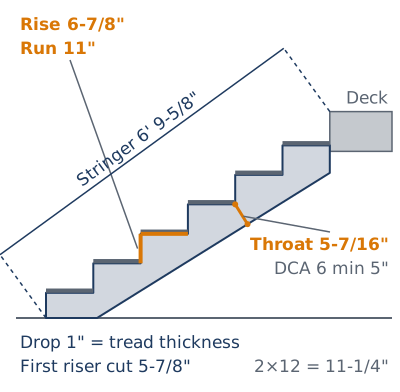
The throat is the actual depth of a 2x12 (11-1/4", PS 20) minus the notch depth, R × T ÷ √(R² + T²), where R is the riser height and T the tread depth. It is checked against the 5" minimum in DCA 6 Figure 28. The stringer count is the stair width ÷ 18" spacing, rounded up, plus one, and never fewer than 3. The flight's run is checked against the 6 ft cut-stringer span. Above 12 ft of total rise the calculator splits the stair into equal flights with a landing between them. The bottom drop equals the tread thickness. The board length is the diagonal rounded up to the next even foot. All maths runs in metres, and the unit toggle only changes what you see.
Sources: Stringer size, throat, span, spacing, landing and width: AWC DCA 6-15, Prescriptive Residential Wood Deck Construction Guide, pages 20–21 and C12; 2x12 depth and standard lengths: NIST PS 20-25, American Softwood Lumber Standard, Table 3 and section 5.3.1; 5/4 deck board thickness: ProWood lumber dimensions chart, checked 2026-10-30. Riser and tread limits are the IRC values used by the stair calculator.
Important: this is a layout estimate, not an engineered stair. It applies the prescriptive limits of the AWC deck guide, DCA 6, which are written for deck stairs. Any stair outside those limits, and interior stairs your code treats differently, should be designed or checked by a professional or your building department before you cut.
Worked example: stairs for a 48 in deck
The deck surface is 48" above the landing pad, the treads are 11" deep, made of 1" deck boards (5/4 decking), and the stair is 36" wide. 48 ÷ 7.75 = 6.19, rounded up to 7 risers of 6-7/8", with 6 treads and 6 × 11 = 66" of run. The stringer diagonal is √(48² + 66²) = 6' 9-5/8", so each stringer comes from an 8 ft 2x12. The notch takes 5-13/16" out of the 11-1/4" board, leaving a throat of 5-7/16", which passes the 5" minimum. The 66" run is within the 6 ft span limit. A 36" stair needs 3 stringers. Cut 1" off the bottom, so the first riser on the stringer is 5-7/8".
A second example: a 13 ft high deck needs a landing
The deck is 156" (13 ft) above grade, more than the 12 ft DCA 6 allows in one flight, so the rise splits into 2 flights of 78". Each flight has 78 ÷ 7.75 = 10.06, so 11 risers of 7-1/16", with 10 treads of 10" for 100" of run. Each stringer is √(78² + 100²) = 10' 6-13/16", so buy 12 ft 2x12s. The throat is 5-7/16", which passes. At 48" wide the stair needs 4 stringers per flight, 8 in all. With 1-1/2" 2x treads the first riser is cut to 5-9/16". The 100" run is over the 6 ft span, so each flight needs a 4x4 post under the stringers, or a design checked by a professional.
Common mistakes
Forgetting the bottom drop
If you cut the bottom riser the same as the others, the first step ends up one tread thickness taller and the top step one thickness shorter. The first and last risers then differ by twice the tread thickness, far more than the 3/8" variation the IRC allows. Cut the bottom riser short by the tread thickness.
Laying out at the maximum riser instead of equal risers
Stepping 7-3/4" risers off a framing square until you run out of height leaves a short odd riser at the top or bottom. Divide the total rise by the riser count and use that equal height on every step.
Using a 2x10 because it is cheaper
A 2x10 is 2" shallower than a 2x12, and the notches take the same amount out of both. DCA 6 calls for 2x12 stringers; a 2x10 leaves far less than the 5" throat.
Buying the board by the run or the rise alone
The stringer runs on the diagonal, so it is longer than either the run or the rise. A 66" run with a 48" rise needs a board over 6' 9", not a 6 ft board.
Measuring the rise at the house on sloping ground
Grade often falls away from the house. Measure at the spot where the bottom of the stringer will bear, after any landing pad is in place.
When this layout stops applying
- Total rise over 12 ft: the calculator splits it into equal flights. The landing between them is a separate freestanding deck, and its length is not in the total run.
- Throat under 5": use a shorter run per step, down to the 10" IRC minimum, to make the notches smaller. If it still fails, the stair needs another design.
- Horizontal span over 6 ft: DCA 6 allows a 4x4 post under the stringers or an intermediate landing. Longer unsupported cut stringers are outside this tool.
- Solid (uncut) stringers with treads on ledgers, housed stringers and winders: these are laid out differently, and this calculator does not cover them.
- Sloping or soft ground: DCA 6 has the stringers bear on posts and footings, not on a patio or pad that is not founded deep enough. Footing design is outside this tool.
- Boards longer than 24 ft: no standard length in the range used here covers the diagonal. Add a landing or have the stair designed.
- Local codes: jurisdictions can amend riser, tread, width and landing rules. The limits here are the model IRC riser and tread values and the DCA 6 deck-stair limits.
FAQ
How long of a 2x12 do I need for stair stringers?
Find the stringer's diagonal, √(total rise² + total run²), then buy the next standard length up. For a 48 in deck with 11 in treads that is 7 risers and 6 treads, 66" of run, and a stringer 6' 9-5/8" long, so an 8 ft 2x12 is enough. The calculator rounds up to even feet, one of the two length steps PS 20 allows. The diagonal is slightly longer than the board the cut layout actually uses, so the length always fits.
What is the throat of a stair stringer, and how deep must it be?
The throat is the wood left between the inside corner of each notch and the bottom edge of the stringer, measured square to that edge. It is all that carries the stair once the notches are cut. The AWC deck guide, DCA 6, shows a minimum of 5" for a cut stringer. A 2x12 is 11-1/4" deep (PS 20), and a notch of 7-3/4" rise and 10" run takes about 6-1/8" out of it, leaving about 5-1/8". DCA 6's own commentary says it analyzed cut stringers with a 5.1" depth for that same 7.75:10 rise to run ratio.
Can I use 2x10s for stair stringers?
Not under DCA 6: "All stringers shall be a minimum of 2x12." A 2x10 is only 9-1/4" deep (PS 20). After a notch of 7-3/4" rise and 10" run, about 3-1/8" would be left, well under the 5" minimum throat. That is why this calculator only lays out 2x12 stringers.
How many stringers do I need for a 36 inch wide stair?
A 36" stair needs 3 stringers. DCA 6 requires at least 3 cut stringers and spaces them no more than 18" on center, so a 36" stair is 2 spaces wide and takes 3 stringers. A 48" stair is 3 spaces wide and takes 4. 36" is also the minimum stair width DCA 6 gives.
Why cut the tread thickness off the bottom of the stringer?
So the first step is the same height as the others. Every tread sits on top of its notch and raises that step by its own thickness, but nothing sits under the bottom of the stringer. Cutting the tread thickness off the bottom lowers the whole stringer by that much. With 1" deck boards (5/4 decking) the bottom riser on the stringer is cut 1" shorter than the others, and with 2x treads 1-1/2" shorter.
When does a stair need a landing?
DCA 6 requires an intermediate landing when the total vertical height of the stairway is more than 12 ft, and the landing must be built as a freestanding (non-ledger) deck using the guide's details. Above 12 ft, the calculator splits the rise into equal flights, each under the limit, and lays out the stringers for one flight. Your local code may set its own limit for interior stairs, so check it.
What if the stringer spans more than 6 feet?
DCA 6 limits an unsupported cut stringer to 6 ft of horizontal span. Past that, the guide lets you put a 4x4 post under the stringers or add an intermediate landing to shorten the span. A long flight that cannot take either needs a stair designed for it, so have it checked by a professional before you cut.
Where do I measure the total rise?
From the finished surface at the bottom to the finished surface at the top: grade, a landing pad or the lower floor up to the deck boards or the upper floor. If the ground slopes, measure where the bottom of the stair will land, not at the house. A wrong total rise changes every riser, so measure it twice.
Does this work for interior stairs?
It lays out the stringers the same way, but the checks are DCA 6 deck-stair limits, which are strict. Interior stairs often have stringers supported along a wall, housed stringers or winders, which DCA 6 does not cover. Use the result as a layout check, and have an interior stair, or any stair outside these limits, reviewed by a professional or your building department.
Why does the board length round up to even feet?
The American Softwood Lumber Standard (PS 20) sets standard lengths in multiples of 1 ft or 2 ft, depending on the grading rules, and SPIB gives 6 to 24 ft as the range for dimension lumber. Rounding up to the next even foot never leaves you short. Which lengths a yard stocks varies, especially past 16 ft.