Blown-In Insulation Calculator
Find how many bags of loose-fill fiberglass or cellulose to blow over your attic floor, and how deep to blow them, for the R-value you want.
Attic floor and product
Measure existing insulation between two joists, down to the ceiling drywall, at the thinnest typical spot.
Results
For a 40 ft × 25 ft attic floor (1000 sq ft) using the Owens Corning AttiCat Expanding Blown-In PINK FIBERGLAS chart at R-49, blow at least 25 bags to a depth of at least 17 in.
Bags to buy
25 bags
Both are required: at least 25 bags and an installed depth of at least 17 in. The chart's R-value holds only when the bag count and the depth are both met.
That's a typical amount for a whole attic floor or a deep top-up.
Plan the blowing machine time and a second person to feed the hopper while you blow, and keep count of empty bags against the depth marks as you work across the attic.
Install to (minimum installed thickness, from the drywall): 17 in
Chart's minimum settled thickness at R-49: 17 in
Minimum weight of the insulation you add: 688 lb
Attic floor area: 1000 sq ft
Raw computed amount: 25.00 bags
How this works
To find how many bags of blown-in insulation you need, read the row for your target R-value on the coverage chart printed on the bag, multiply its bags per 1,000 sq ft by your attic floor area ÷ 1,000, and round up to a whole bag. Then blow those bags to at least the row's minimum installed thickness. For 1,000 sq ft at R-38 with Owens Corning AttiCat, that is 19 bags blown at least 13.5 in deep.
Every bag carries this chart because the FTC R-value Rule requires loose-fill labels to show: “For all loose-fill insulation: the minimum settled thickness, initial installed thickness, maximum net coverage area, number of bags per 1,000 square feet, and minimum weight per square foot at R-values of 13, 19, 22, 30, 38, and 49.” Source: FTC R-value Rule, 16 CFR 460.12, checked 2026-10-30.
The two figures work together: "The applicator must install both the minimum number of bags per 1000 sq. ft. and the minimum installed thickness to ensure the stated R-value has been reached." That is the Greenfiber chart's wording, and Owens Corning's AttiCat instructions say the same. That is why the results always show the bag count and the depth together, plus the minimum weight where the preset chart lists one.
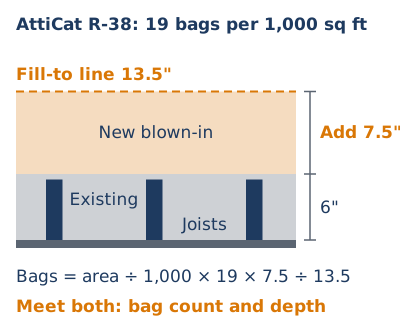
When there is insulation on the floor already, the depth to add is the chart's installed thickness minus the depth you measure, the method on Owens Corning's AttiCat data sheet. The bags for that top-up are the chart's bags scaled by the added depth ÷ the chart depth, and the minimum weight is scaled the same way. That scaling is a calculator assumption, not a manufacturer figure: it treats the old layer as performing like the new product inch for inch. In all three preset charts bags per inch rise with depth, so the scaled figure is never below what the chart lists for a thinner row.
Which R-value to aim for is a climate decision, not a calculation input. For attics, ENERGY STAR recommends R-30 to R-49 in the warmest US climate zones (1–2), R-38 to R-60 in moderate zones (3–5), and R-49 to R-60 in the coldest zones (6–8). The R-value chart by climate zone lists the figure for every zone, including the smaller top-up level for an attic that already has some insulation.
The presets come from three manufacturer charts, copied row for row. Use the table for the product you are buying; another brand's rows do not transfer.
Owens Corning AttiCat Expanding Blown-In PINK FIBERGLAS
| R-value | Bags per 1,000 sq ft | Min. installed thickness | Min. settled thickness | Max. coverage per bag | Min. weight |
|---|---|---|---|---|---|
| R-13 | 5.9 | 5 in | 5 in | 169.8 sq ft | 0.162 lb/sq ft |
| R-19 | 9 | 7 in | 7 in | 110.7 sq ft | 0.248 lb/sq ft |
| R-22 | 10.5 | 8 in | 8 in | 94.8 sq ft | 0.29 lb/sq ft |
| R-26 | 12.6 | 9.5 in | 9.5 in | 79.3 sq ft | 0.347 lb/sq ft |
| R-30 | 14.6 | 10.75 in | 10.75 in | 68.5 sq ft | 0.402 lb/sq ft |
| R-38 | 19 | 13.5 in | 13.5 in | 52.6 sq ft | 0.523 lb/sq ft |
| R-44 | 22.4 | 15.5 in | 15.5 in | 44.6 sq ft | 0.616 lb/sq ft |
| R-49 | 25 | 17 in | 17 in | 39.9 sq ft | 0.688 lb/sq ft |
| R-60 | 31.5 | 20.5 in | 20.5 in | 31.8 sq ft | 0.866 lb/sq ft |
Nominal bag weight 27.5 lb; coverage determined with an AttiCat machine and a 2.5-inch hose. Owens Corning states settling is negligible. Source: Owens Corning, "AttiCat Expanding Blown-in PINK FIBERGLAS Insulation — Application Instructions", Pub. No. 10009393-E (November 2022), coverage chart columns: minimum bags per 1,000 sq ft, maximum coverage per bag, minimum weight in lb/sq ft, minimum initial installed thickness, minimum settled thickness, checked 2026-10-30.
Johns Manville Attic Protector B-785 fiberglass blowing wool
| R-value | Bags per 1,000 sq ft | Min. installed thickness | Min. settled thickness | Max. coverage per bag | Min. weight |
|---|---|---|---|---|---|
| R-11 | 5.1 | 5 in | 4.9 in | 192.2 sq ft | 0.131 lb/sq ft |
| R-13 | 6 | 5.8 in | 5.7 in | 162.3 sq ft | 0.155 lb/sq ft |
| R-19 | 9 | 8.2 in | 8.1 in | 109.3 sq ft | 0.231 lb/sq ft |
| R-22 | 10.5 | 9.4 in | 9.2 in | 93.4 sq ft | 0.27 lb/sq ft |
| R-26 | 12.7 | 10.9 in | 10.8 in | 77.9 sq ft | 0.324 lb/sq ft |
| R-30 | 14.9 | 12.4 in | 12.3 in | 66.5 sq ft | 0.379 lb/sq ft |
| R-38 | 19.4 | 15.3 in | 15.2 in | 51 sq ft | 0.494 lb/sq ft |
| R-44 | 22.9 | 17.4 in | 17.3 in | 43.3 sq ft | 0.583 lb/sq ft |
| R-49 | 25.9 | 19.1 in | 18.9 in | 38.3 sq ft | 0.658 lb/sq ft |
| R-60 | 32.6 | 22.6 in | 22.5 in | 30.5 sq ft | 0.827 lb/sq ft |
The attic card does not print the bag weight or blowing machine; both are on the bag label. Source: Johns Manville, "Attic Protector B-785 Fiberglass Blowing Wool Insulation — Attic Coverage" card, BID-356 1/19, Attic Protector Blow-In Coverage Chart, checked 2026-10-30.
Greenfiber Sanctuary cellulose (25 lb bag)
| R-value | Bags per 1,000 sq ft | Min. installed thickness | Min. settled thickness | Max. coverage per bag | Min. weight |
|---|---|---|---|---|---|
| R-11 | 12.7 | 3.3 in | 3 in | 78.6 sq ft | 0.32 lb/sq ft |
| R-13 | 15.2 | 3.9 in | 3.6 in | 65.8 sq ft | 0.38 lb/sq ft |
| R-19 | 22.6 | 5.7 in | 5.3 in | 44.2 sq ft | 0.57 lb/sq ft |
| R-22 | 26.3 | 6.6 in | 6.1 in | 38 sq ft | 0.66 lb/sq ft |
| R-26 | 32.1 | 7.7 in | 7.2 in | 31.2 sq ft | 0.8 lb/sq ft |
| R-30 | 38.6 | 8.9 in | 8.3 in | 25.9 sq ft | 0.97 lb/sq ft |
| R-32 | 42 | 9.5 in | 8.8 in | 23.8 sq ft | 1.05 lb/sq ft |
| R-38 | 52.6 | 11.2 in | 10.4 in | 19 sq ft | 1.32 lb/sq ft |
| R-40 | 56.5 | 11.8 in | 10.9 in | 17.7 sq ft | 1.41 lb/sq ft |
| R-44 | 63.5 | 12.9 in | 12 in | 15.7 sq ft | 1.59 lb/sq ft |
| R-48 | 70.8 | 14 in | 13 in | 14.1 sq ft | 1.77 lb/sq ft |
| R-49 | 72.6 | 14.3 in | 13.3 in | 13.8 sq ft | 1.81 lb/sq ft |
| R-50 | 74.3 | 14.6 in | 13.5 in | 13.5 sq ft | 1.86 lb/sq ft |
| R-60 | 92.5 | 17.3 in | 16.1 in | 10.8 sq ft | 2.31 lb/sq ft |
Based on settled thickness, a nominal bag weight of 22.55 lb and the Greenfiber Monarch blowing machine (settings non-adjustable). Net coverage, no adjustment for framing. Source: Greenfiber, "Do-It Yourself Attic Installation Instructions", DM-6.3-38 Rev E 01-23, Sanctuary Attic Application Coverage Chart 25 lbs — maximum net coverage columns (no adjustment for framing), checked 2026-10-30.
All calculation runs in metres and square metres internally. The unit toggle changes only what you type and see; the chart figures stay in the US label units they are printed in.
Worked example: a bare attic floor in cellulose
A 30 ft × 40 ft attic floor with no insulation, filled to R-49 with Greenfiber Sanctuary cellulose: the area is 30 × 40 = 1,200 sq ft. The R-49 row lists 72.6 bags per 1,000 sq ft, so 1,200 ÷ 1,000 × 72.6 = 87.12 bags, rounded up to 88 bags. Blow them to at least 14.3 in; after settling the chart expects 13.3 in. The row's minimum weight of 1.81 lb per sq ft means the finished layer should weigh at least 2,172 lb across the whole floor.
A second example: topping up an attic in fiberglass
A 1,000 sq ft attic floor that already holds 6 in of old insulation, topped up to R-38 with Owens Corning AttiCat: the R-38 row lists 19 bags per 1,000 sq ft at 13.5 in. The depth to add is 13.5 − 6 = 7.5 in, measured up from the top of the old layer. The bags scale by that share of the chart depth: 19 × 7.5 ÷ 13.5 = 10.56, rounded up to 11 bags. The added layer should weigh at least 291 lb. Blow until the new surface reaches the 13.5 in mark measured from the drywall.
A third example: typing in your own label
Your bag is not one of the presets, so you choose "My bag's label" and copy the R-30 row from its chart. Say the row reads 14.9 bags per 1,000 sq ft and 12.4 in minimum installed thickness (the Johns Manville Attic Protector figures). For an 850 sq ft attic floor that is 850 ÷ 1,000 × 14.9 = 12.67, rounded up to 13 bags, blown at least 12.4 in deep. No minimum weight is shown, because you did not type one in; check the label's weight column against the bag weight times 13 bags yourself.
Common mistakes
Counting bags and ignoring depth, or the other way round
The chart has two requirements and you have to meet both: the bag count and the installed thickness. Blowing the full bag count but stopping short of the depth, or reaching the depth with fewer bags than the chart lists, leaves the layer short of the R-value printed on the bag. Count the empty bags as you go, and check the depth marks before you stop.
Using one brand's chart for another brand's bag
At R-38 the AttiCat chart lists 19 bags per 1,000 sq ft, the Johns Manville Attic Protector chart 19.4 and the Greenfiber Sanctuary chart 52.6. The depths differ too: 13.5, 15.3 and 11.2 in. Pick the preset that matches your bag, or type in the figures from your own label.
Measuring old insulation on top of a joist
Push the ruler down between two joists until it touches the ceiling drywall, and read the depth there. The top of a joist shows only what lies over the wood, and a spot by the hatch is usually the most trampled part of the attic. Measure in several places and use the thinnest typical reading.
Rounding the bag count down
The calculator rounds up to the next whole bag because the chart figure is a minimum. A layer that comes up a few bags short is a layer that does not reach its R-value somewhere, usually in the corners you blow last. An unopened bag is usually easier to return than a second machine rental is to arrange.
Changing the blowing machine or the bag size
Each chart is measured with a stated bag and machine, printed with the chart: the AttiCat chart with an AttiCat machine and the Greenfiber chart with its Monarch machine (the tables above list each basis). A different machine or setting can blow the same bag looser or denser, so if you rent different equipment, check the depth marks more often.
Blowing insulation into the eaves
Loose fill drifts into the soffit area and can block the air path that keeps an attic dry. Fit baffles at the eaves before you blow and keep the vent channel open. The bag count does not change, but a blocked vent turns a good estimate into a moisture problem.
When this estimate stops applying
- Uneven existing insulation: if the old layer is 3 in in one area and 8 in in another, run the calculator once per area with its own floor area and depth, then add the bag counts.
- Products not in the presets: use the label override with your bag's row. Any chart that lists bags per 1,000 sq ft and minimum installed thickness works; the minimum weight is then not shown.
- Walls, floors over crawlspaces and sloped ceilings: the presets are attic charts for open blowing onto a flat floor and do not cover closed cavities.
- Old insulation that is wet, mouldy or full of pest debris: it needs removing or drying first, and its depth should not be counted as existing insulation.
- Metric markets: the calculator converts your area, depths and weights, but the charts themselves are US labels with bags per 1,000 sq ft. A bag sold in another market carries its own chart in its own units.
- Recessed lights, chimneys and flues: keep loose fill away from them as the bag label and your local code require. The covered area barely changes, but the clearance has to be built before you blow.
- Very small areas such as a hatch-sized patch: the whole-bag round-up dominates, and a single bag is the minimum you can buy.
FAQ
How many bags of blown-in insulation per 1,000 sq ft for R-38 or R-49?
It depends on the product, so read it off your own bag. For 1,000 sq ft at R-38, the charts on this page list 19 bags of Owens Corning AttiCat, 19.4 of Johns Manville Attic Protector and 52.6 of Greenfiber Sanctuary cellulose. At R-49 the same charts list 25, 25.9 and 72.6 bags, at depths of 17, 19.1 and 14.3 in.
Why do cellulose and fiberglass need such different bag counts?
Because one bag of each covers a very different area at the same R-value. At R-49 the Greenfiber Sanctuary cellulose chart lists 72.6 bags per 1,000 sq ft, while the Owens Corning AttiCat fiberglass chart lists 25. Cellulose is installed much denser (at least 1.81 lb per sq ft against 0.688 lb for AttiCat), and the bags themselves weigh different amounts. A bag count only means something next to the chart for the bag you are buying.
Should I blow to the installed thickness or the settled thickness?
Blow to the installed thickness; the settled thickness is where the chart expects the layer to end up later. Greenfiber's Sanctuary chart, for example, lists 14.3 in installed and 13.3 in settled at R-49. Owens Corning states that AttiCat settling is negligible and prints the same figure in both columns. The "install to" depth in the results is always the installed column.
My bag's chart is not one of the presets. Can I still use this?
Yes. Choose "My bag's label" and type two numbers from the row for your R-value: the bags per 1,000 sq ft and the minimum installed thickness. The FTC R-value Rule requires every loose-fill bag sold in the US to carry that chart, so any brand has these figures on the bag. The minimum weight is not shown in that mode, because the calculator has no weight figure to work from.
What if the R-value I want falls between two chart rows?
Use the next row up on your product's chart. The charts give figures only at the listed R-values, and this calculator never interpolates between rows. For R-45 that is R-49 on Owens Corning AttiCat, R-49 on Johns Manville Attic Protector and R-48 on Greenfiber Sanctuary, because the rows on offer differ by brand.
Should I subtract the joists from the attic floor area?
No, enter the full floor area between the outside walls. The charts give net coverage, and Greenfiber's states that no adjustment is made for framing. The joists fill a little of the depth the insulation would otherwise take, so leaving them in the area gives a small margin rather than a shortfall.
How exact is the bag count when I enter existing insulation?
It is an estimate, and it is the one part of this page that rests on BuildyWork's own assumption rather than a manufacturer's figure. The depth to add follows Owens Corning's method of subtracting what is already there. The bag count then assumes the old layer insulates as well per inch as the new product. Old insulation that is compressed, damp or a different material can do less, so measure the thinnest typical spot and treat the result as a minimum. Reach both the bag count and the fill-to line: if the surface hits the line with bags left, keep blowing past it until they are used, and if the bags run out first, buy more. Greenfiber's DIY guide uses a different method, subtracting the R-value you have from the one you want, and over fiberglass batts it can ask for a slightly deeper added layer than this page.
Does the minimum weight matter if I blow the right number of bags?
It is the label's second check on the same layer: depth alone can be reached by blowing the material too loose, and the weight per square foot ties the depth to the amount of material. If you spread the full bag count evenly over the whole area, the weight follows. The results show the minimum weight of the insulation you add, so you can compare it with your bag weight times the number of bags.
Can I use these charts for walls or a cathedral ceiling?
No. The presets are attic charts for loose fill blown open onto a flat attic floor. Filling a closed wall cavity or a sloped ceiling is a different installation at a different density, so follow the manufacturer's instructions for that use, if the product is rated for it at all, rather than an attic row.
How do I know when I have reached the right depth while blowing?
Fix rulers or marked sticks to the joists across the attic before you start, each marked at the chart's installed thickness, and blow until the surface is level with every mark. Check the far corners and the area around the hatch last, because those are the spots that most often end up thin.
Embed this calculator
Add this calculator to your own site — free, no signup, links back to BuildyWork.
<iframe src="https://buildywork.com/embed/blown-in-insulation" title="Blown-In Insulation Calculator for Attics" width="100%" height="900" style="border:1px solid #ddd;border-radius:8px;max-width:480px" loading="lazy"></iframe>
<p style="font:12px sans-serif;margin:4px 0 0;max-width:480px"><a href="https://buildywork.com/insulation/blown-in-insulation-calculator" target="_blank" rel="noopener">Blown-In Insulation Calculator for Attics by BuildyWork</a></p>